Is America a Democracy or a Republic?

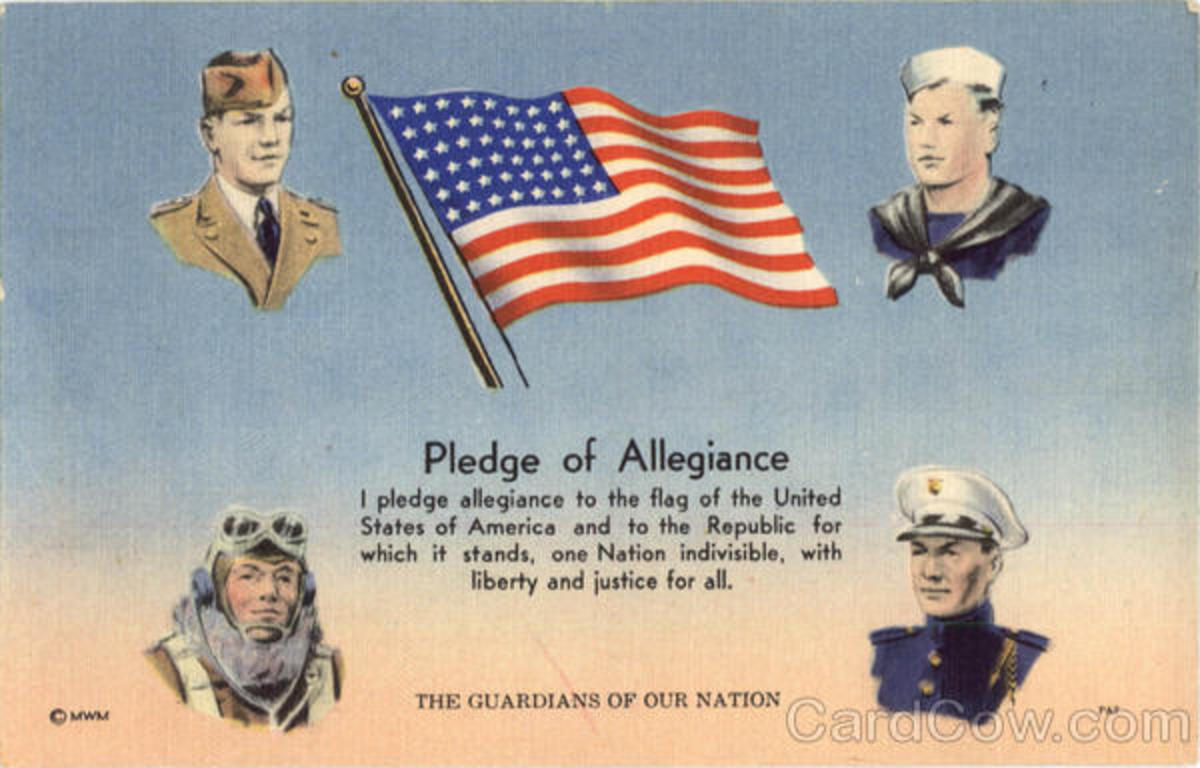
The Pledge of Allegiance
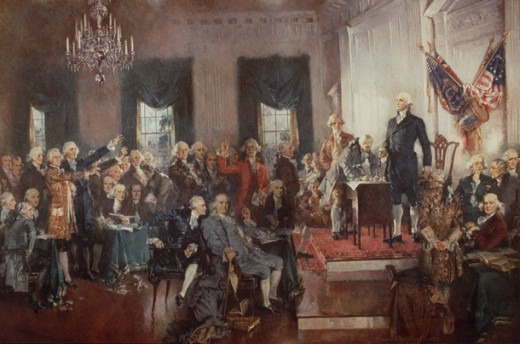
When I came to America, I was 8 years old and made to say the pledge of allegiance in elementary school. I felt a little odd about it. When I had my hand on my heart and pledged allegiance to the American flag, and to the Republic for which it stands, I experienced a sort of revulsion. Not to America, and not to the government because I had no understanding of government, but to the idea of pledging allegiance to a republic. It wasn't even that I understood what a republic was, but the very fact that I had to stand up with everyone else, with my hand on my heart and repeat that chant, made me feel less like a person, and that something dominant and scary was overseeing my life.
I never had to do that in Holland. Never. It was required here, and the funny thing is that being forced to say the pledge of allegiance did not make me care more for America. I have a warmer place in my heart for my tiny home country of Holland than I do for America. Don't get me wrong, I do love America, and I appreciate the great things America has done for the world. If it wasn't for Americans, we would all be speaking German. Americans were the first to break the sound barrier through a mixture of guts and engineering. America gives the world hope in the form of democracy and free speech.
Dividing the Truth from Perspective
But what does the word "republic" mean? It’s very simple. I found a weird description in Wikipedia: "A republic is a state or country that is not led by a hereditary monarch, in which the people (or at least a part of its people) have an impact on its government". So now we know what it isn't and how it is affected. But can the absence of definition truly define something? That's like saying God is not the Devil. Great. Now can someone tell me what God is? Well, God is love. But I digress. Let's take a look at the Oxford American Dictionary, copyright 1980: "A country in which the supreme power is held by the people or their elected representatives, or by an elected or nominated president". Now we are getting somewhere.
Just as an interesting side note. We must be vigilant to watch how history is twisted and distorted by rewritten text books, redefined definitions or altered perspectives from presumed objective viewpoints that use different facts, especially on the internet. The Wikipedia version may or may not have had malicious intent, but if we start defining a thing by what it is not, then anyone that comes along who assumes to be an authority, can then define what that something is, because the definition is open to interpretation. Especially in our current education climate, where students no longer learn as much as they did before, but are even taught twisted truths instead, (protected sex is better than abstinance or teaching that evolution as a fact when in fact it is only a theory that has many opponents for example). I think I'm going to go look for a set of forty year old encyclopedias, published in a time when not everything was considered open to interpretation. It may not have the current periodic table, but at least I'll have a base of unbiased knowledge which I can reference and compare simple facts with. Back to the main subject.
Mob Rule or Democracy?
America was founded as a republic. But what is America today? America is still a republic. One that uses a democratic process to maintain its political leadership. Obviously a republic couldn't exist without the democratic process, so it follows that America is also a democracy. Its defining characteristic is that power ultimately rests with the people. The Oxford Dictionary defines democracy as: "Government by the whole people of a country, especially through representatives whom they elect". Wikipedia again slightly alters the meaning, but it is much much more subtle: "Democracy is a form of government in which state-power is held by the majority of citizens within a country or a state". Did you see it? The 1980 definition suggest unity when it says "whole people," when Wikipedia says "the majority of citizens," which suggests that majority rules. Both definitions can be accepted as being equal, but it is important to point out there are some proponents of republicanism that feel strongly the original intent of the Constitution was to protect individual rights versus mob-rule. If you’re really paranoid, you might see this is an attempt to remove the idea that the founders advocated individualism. Then again, just because you’re paranoid does not mean that someone isn’t really chasing you.
If it is meant to be individualism over mob-rule, then America is certainly not a democracy, but does employ democracy in choosing new leaders. Technically, the answer to the main question is yes. America is both a republic and a democracy, but it is only a democracy by default because it is necessary for a republic to be a democracy in order to exist. The entire argument about whether it is one or another seems to be more about dividing people into groups, or differentiating between the purpose of democracy in America versus what is defined as democracy today.
What's in a Name?
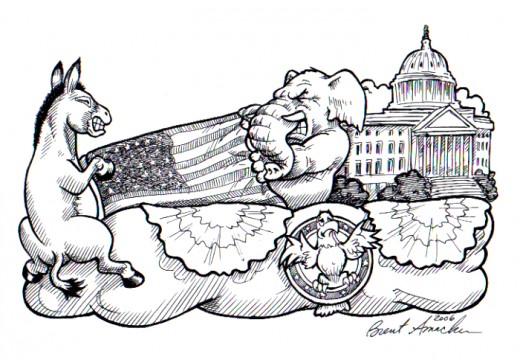
Whether America the republic and the democracy is defined by the political parties of the same names, is another subject entirely. When considering the motives of the founding fathers, they advocated individualism, an opposite sentiment than what the Democrats would like to see in government. We were never meant to be subjects of the government, but we find ourselves inadvertently halfway in that position today. The U.S. government acts more like a monarchy than a nation ruled by its people as temporary taxes become permanent. As police officers are tasked with giving us tickets for not wearing seatbelts in our own cars and helmets while riding our own motorcycles. As tolls meant to pay for bridge construction are continued even after they have done the job.
Except for national health care, and other like cases where competition becomes a disadvantage to the people’s best interests, limited government and a free market is generally a greater benefit to society, and would work well if politicians ever gave it the room it would need to prosper. With the bailouts, certain businesses that should have failed and naturally been replaced by another corporation that could do it better, now continue to survive, like proverbial ticks gorging itself on the family dog.
Today's Democrats do not represent the democracy intended for the republic of America, so the truth is that America is not a democracy as democracy is described today. But in its purest form, we can say that America is a democratic nation.
I Pledge Allegiance
As to my feelings about the pledge of allegiance, I now understand what the founders intended. They wanted a strong nation that was united under a powerful president but also answerable to the people to limit that power so its citizens would not become the subjects of its own government. I still prefer socialism, at least the best examples of socialism in Western Europe, but American democracy gives control to the people, and it has been proven to work. America is prosperous, leading the world in technology and military strength, sending out the most missionaries and giving the most aid to other countries. If I decide to become a citizen at some point, I will be happy to say the pledge of allegiance.
- Republic America: The Nature of Republican Government
An interesting perspective about the republic and individualism.